There's a phrase we hear regularly when talking with businesses about their communications infrastructure:
"Our phone system works fine. Why would we replace it?"
It's a fair question.
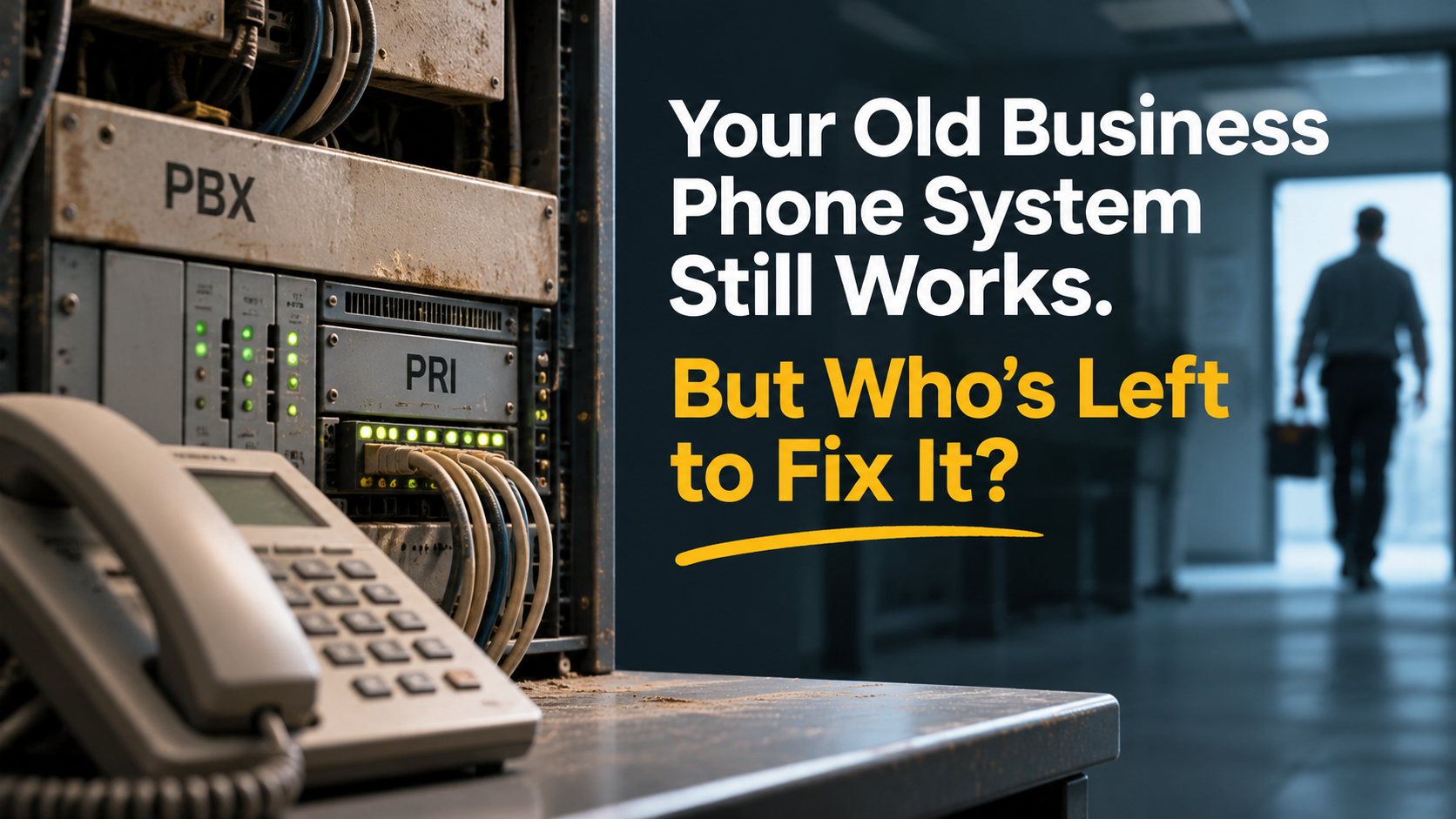
Many businesses are still operating traditional on-premises PBX systems connected through PRI (Primary Rate Interface) circuits. Some of these systems have been running reliably for 15, 20, or even 25 years.
Employees know how to use them. Customers can reach the business. The phones ring, calls transfer, and voicemail works.
From the business owner's perspective, there's no problem to solve.
But there's a question that often gets overlooked:
What happens when something needs to change?
Consider a common scenario.
A business has an older PBX connected to a traditional PRI phone circuit. The company decides to upgrade its internet connectivity, change telecommunications providers, or consolidate services to reduce costs.
Nothing about the phone system itself needs to change. The business simply wants better connectivity or more competitive pricing while keeping its existing phones.
On paper, the transition looks straightforward.
The current provider delivers PRI service. The new provider also offers PRI service. The existing phone system should continue operating.
But once the installation begins, the technical team discovers that the new carrier's PRI configuration doesn't match what the older PBX expects.
Suddenly, what was supposed to be a routine carrier transition becomes a troubleshooting project.
The issue might involve signaling protocols, digit formatting, timing, physical connections, or other configuration details.
These problems aren't necessarily insurmountable. In many cases, they're solvable.
The real challenge is finding someone who understands both the older phone system and the newer carrier infrastructure well enough to make them work together.
For decades, traditional business phone systems were supported by technicians who specialized in PBX programming, T1 circuits, PRI signaling, and carrier interconnections.
They knew the equipment, understood its limitations, and could troubleshoot problems that most general IT professionals rarely encountered.
But the telecommunications industry has changed dramatically.
Modern business communications increasingly run on IP networks and cloud-based platforms. IT teams now spend their time managing cybersecurity, wireless networks, cloud applications, remote workers, and business continuity.
Traditional PBX and PRI expertise is no longer a routine part of many IT support environments.
At the same time, manufacturers have discontinued older equipment, support contracts have expired, and experienced technicians have retired or moved into other specialties.
The result is a growing support gap.
A company may have a phone system that still functions perfectly, but nobody available who can confidently reprogram it, replace a failed component, or troubleshoot a carrier compatibility issue.
That's a different kind of technology risk.
The equipment hasn't necessarily reached the end of its useful life. Its support ecosystem may have.
One of the biggest misconceptions about legacy technology is that leaving it alone eliminates risk.
In reality, business infrastructure rarely exists in isolation.
Even when a company has no intention of replacing its phone system, other changes can affect it.
A carrier may discontinue a service or change its delivery method. An internet upgrade may require new network equipment. A business may relocate, add an office, or need different call-routing capabilities.
Each change creates another point where an older phone system must interact with newer technology.
And while PRI is an established telecommunications standard, that doesn't mean every provider delivers service with identical configurations.
A legacy PBX might require specific signaling settings, inbound digit presentation, or physical interface configurations.
If those settings aren't matched correctly, calls may not route as expected—or the system may fail to establish a working connection.
What looked like a simple service migration can suddenly depend on specialized knowledge that isn't readily available.
For businesses that rely heavily on incoming customer calls, even a short disruption can affect sales, customer service, and daily operations.
Businesses often evaluate phone systems based on their monthly operating costs.
If the equipment is paid for and the current service is affordable, keeping it can appear to be the most economical decision.
But the monthly bill doesn't tell the entire story.
There's also the cost of maintaining the system, locating replacement parts, finding qualified support, and managing unexpected disruptions.
Consider these questions:
If those questions are difficult to answer, the company may be carrying more operational risk than it realizes.
And that risk may remain invisible until the business needs to make a change.
Not necessarily.
Some older PBX systems remain dependable and can continue operating effectively with appropriate support.
The goal shouldn't be to replace functioning technology simply because it's old.
Instead, businesses should understand the limitations of what they have and make informed decisions before those limitations become urgent problems.
That starts with a practical assessment of the existing phone system, its supportability, its connection to the carrier network, and the organization's future communications needs.
For some companies, maintaining the existing system for another year or two may be reasonable.
For others, transitioning to a modern hosted phone system or another IP-based solution may reduce support complexity and provide greater flexibility.
Either way, the best time to evaluate those options is before a failure forces the decision.
One of the biggest advantages of planning ahead is control.
When a company evaluates its communications infrastructure while everything is still working, it can compare options, establish a budget, coordinate with its IT provider, and schedule a transition around business operations.
When a critical system fails unexpectedly, those choices become much more limited.
Instead of evaluating what makes the most sense for the business, the immediate priority becomes getting the phones working again.
That's rarely the best environment for making a long-term technology decision.
At TTSX, we help businesses evaluate their existing telecommunications and network infrastructure, understand where potential risks exist, and develop practical strategies for improving reliability without creating unnecessary disruption.
Sometimes that means keeping the existing system and making sure it's properly supported.
Other times, it means building a plan to move away from technology that's becoming increasingly difficult to maintain.
The important thing is knowing the difference.
Because the question isn't just whether your phone system works today.
It's whether you'll have the people, parts, and support available to keep it working tomorrow.
Before your next carrier renewal, internet upgrade, or office move, it may be worth taking a closer look at how your communications infrastructure is supported.
TTSX helps businesses evaluate their connectivity and communications options, identify potential risks, and plan technology transitions with minimal disruption.
Book a 15-Minute Second-Look Call to discuss your existing phone system and identify a practical next step.