For decades, Michigan proudly carried the title "The Arsenal of Democracy." During World War II, the factories, machine shops, and manufacturing facilities of the Midwest transformed themselves into the industrial backbone of the nation, producing the equipment, vehicles, and components that supported victory abroad.
Today, that phrase is beginning to take on new meaning.
As global supply chains continue to shift, geopolitical tensions rise, and domestic manufacturing becomes a national priority, many manufacturers throughout Michigan and the Midwest are finding themselves presented with opportunities they haven't seen in years. Aerospace, defense, automation, and advanced manufacturing are all experiencing renewed investment, creating potential growth opportunities throughout the industrial supply chain.
The opportunity is real.
But there is a challenge many companies are only beginning to recognize.
The next generation of manufacturing growth will not be determined solely by machine capacity, floor space, or labor availability. Increasingly, it will be determined by how well organizations can support modern requirements for compliance, cybersecurity, connectivity, and communication.
When major defense contractors, aerospace companies, and automotive manufacturers receive new programs, the work doesn't stay at the top.
It flows through the entire ecosystem:
Many smaller and mid-sized organizations assume they are too small to participate in these opportunities. In reality, many of the most critical components and services are delivered by companies with fewer than 100 employees.
The challenge is not getting noticed.
The challenge is being prepared.
Twenty years ago, a manufacturer's competitive advantage was often measured by:
Those factors still matter.
However, many organizations are now discovering that the greatest barriers to growth often exist within their technology infrastructure.
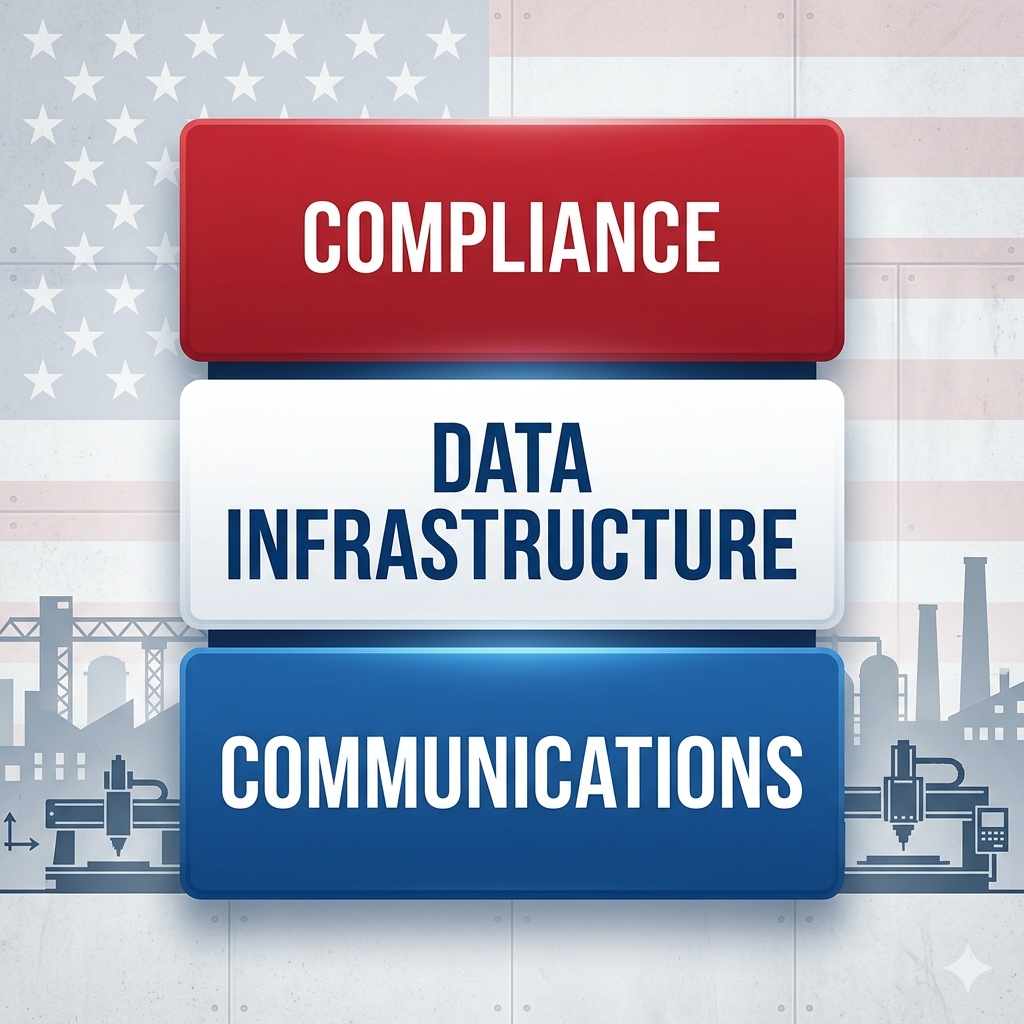
Three areas consistently emerge during conversations with manufacturers across Michigan:
For manufacturers serving aerospace, defense, and government-related industries, cybersecurity has become a hard requirement rather than a best practice.
Frameworks such as:
are no longer optional considerations.
If an organization cannot properly secure sensitive information, engineering drawings, customer data, or controlled technical information, many opportunities never make it past the starting line.
Many smaller manufacturers have historically relied on trust-based relationships and practical security measures. Today's environment increasingly requires documented controls, auditing, access management, and ongoing cybersecurity programs.
The reality is simple:
If you cannot demonstrate compliance, you may not be eligible to bid.
Modern manufacturing depends on data.
Engineering teams move large CAD files between locations. Customers expect instant access to information. Production systems increasingly rely on cloud-based applications, analytics platforms, and real-time collaboration tools.
Yet many organizations are still operating on connectivity environments that were designed for a very different era.
Questions manufacturers should be asking include:
As file sizes grow and applications become more data intensive, bandwidth becomes more than a utility. It becomes a strategic asset.
Organizations that invest in reliable, scalable connectivity position themselves to respond faster and compete more effectively.
Communications systems are often overlooked until something goes wrong.
Many manufacturers still operate on aging phone systems that technically work but no longer support how modern businesses operate.
Today's workforce expects:
Customers expect immediate responsiveness.
Suppliers expect visibility.
Partners expect reliability.
Modern communications systems are no longer separate from operations. They are part of the operational infrastructure itself.
When communication systems become more efficient, organizations become more responsive, more flexible, and ultimately more competitive.
Over the last several months, I have spoken with manufacturers throughout Michigan ranging from small machine shops to larger multi-location operations.
The conversations vary, but the themes are remarkably consistent:
Many companies are not facing immediate crises.
Instead, they are recognizing that future opportunities may require stronger infrastructure than what was sufficient in the past.
The organizations asking these questions today will likely be in a much stronger position tomorrow.
Michigan's manufacturing community has always adapted.
It adapted from automotive production to automation.
It adapted from analog systems to digital systems.
It adapted through recessions, supply chain disruptions, and technological change.
The next chapter will likely require another adaptation.
The companies that thrive over the next decade may not simply be the ones with the newest equipment or largest facilities.
They will be the organizations that combine manufacturing excellence with:
The opportunity is significant.
The investment flowing into domestic manufacturing, defense, aerospace, and industrial modernization will create opportunities throughout the Midwest supply chain.
The question is not whether those opportunities will arrive.
The question is whether your organization will be prepared when they do.
Jason Tyler
Technology Advisor | TTSX
Helping Michigan manufacturers improve communications, connectivity, cybersecurity, and compliance readiness.
#MichiganManufacturing #DefenseIndustry #CMMC #Cybersecurity #Industry40 #Aerospace #Automation #MichiganBusiness #ManufacturingTechnology #ArsenalOfDemocracy