For a long time, enterprise technology conversations have revolved around how people use software.
We talk about user adoption, seat licenses, training curves, and UI updates. We debate whether employees like a specific desktop app or whether a web platform makes data entry 10 percent faster. We treat software as a tool—something a human picks up, operates for eight hours a day, and sets down at five o'clock.
That paradigm is quietly running out of road.
The transition happening across modern businesses isn’t about finding a better app for humans to click on. It’s about the shift from software people use to digital labor businesses deploy.
Moving Past the Tool Phase
If you look closely at how forward-thinking operations are evolving, the objective has changed. Executives are no longer asking how to make manual data entry slightly more efficient. They are asking why a human is handling the repetitive, rules-driven handoffs between systems in the first place.
When you begin building and running semi-autonomous agents—whether it's managing your own digital infrastructure, cleaning up analytics pipelines, or orchestrating marketing workflows—you realize something fundamental. You stop writing code or moving files line by line. Instead, you step into the role of an architect. You define the intent, set the guardrails, and let the system execute the multi-step operational logic.
Tasks that used to require an entire day of manual research, cross-referencing, and debugging collapse into conversational, multi-threaded workflows. You watch an agent simultaneously audit code, rewrite tags, parse data, and structure outputs across multiple browser environments while you steer the outcome.
It is fast, precise, and completely changes the velocity of a business. But it also exposes a hard truth about how our technology stacks are built.
The Hidden Bottleneck: Why Infrastructure is the Real Performance Layer
When your digital operations rely on agents executing tasks in parallel across your enterprise stack, your infrastructure stops being a background utility. It becomes the life-support system for your workforce.
Consider what happens when a digital agent is deep into a complex, multi-threaded optimization task—pulling records, updating configurations, and talking to cloud databases—and your network connection blips.
A human employee might pause for a moment to reconnect to a VPN or grab a coffee. An autonomous agent doesn't take a coffee break. It stalls. The assembly line halts.
In an agentic organization, uptime is no longer just about whether employees can check their email or join a video call. It is about whether your digital labor force can maintain uninterrupted access to the systems, databases, and APIs they need to operate.
This is why traditional network design—relying on a single fragile fiber line or a dormant backup wire sitting in a rack—fails in an automated environment. Active-active bandwidth, enterprise 5G failover, SD-WAN path diversity, and robust cybersecurity aren't luxury line items for tech-forward companies. They are prerequisites. If the pipe drops, your digital workforce goes blind and deaf.
The Economic Pivot: Seats vs. Consumption
As workflows become automated, the financial model changes right alongside the architecture.
For decades, software economics have been anchored to headcount: a flat fee per user, per month. But when an AI agent handles thousands of customer inquiries, processes hundreds of invoices, or continuously monitors infrastructure health without a human ever sitting in front of a screen, seat-based pricing stops making sense.
We are moving toward a consumption-based economic model where intelligence and execution are metered. Much like the transition in telecommunications from fixed line charges to usage economics, businesses will increasingly measure costs by the unit of work completed—per resolved customer interaction, per automated workflow, per token of intelligence consumed.
Managing that cost effectively will require a new kind of operational discipline. Companies will need advisors who understand how to route tasks efficiently, govern data access safely, and prevent runaway token or API consumption from eating up expected margins.
The Role of the Modern Technology Advisor
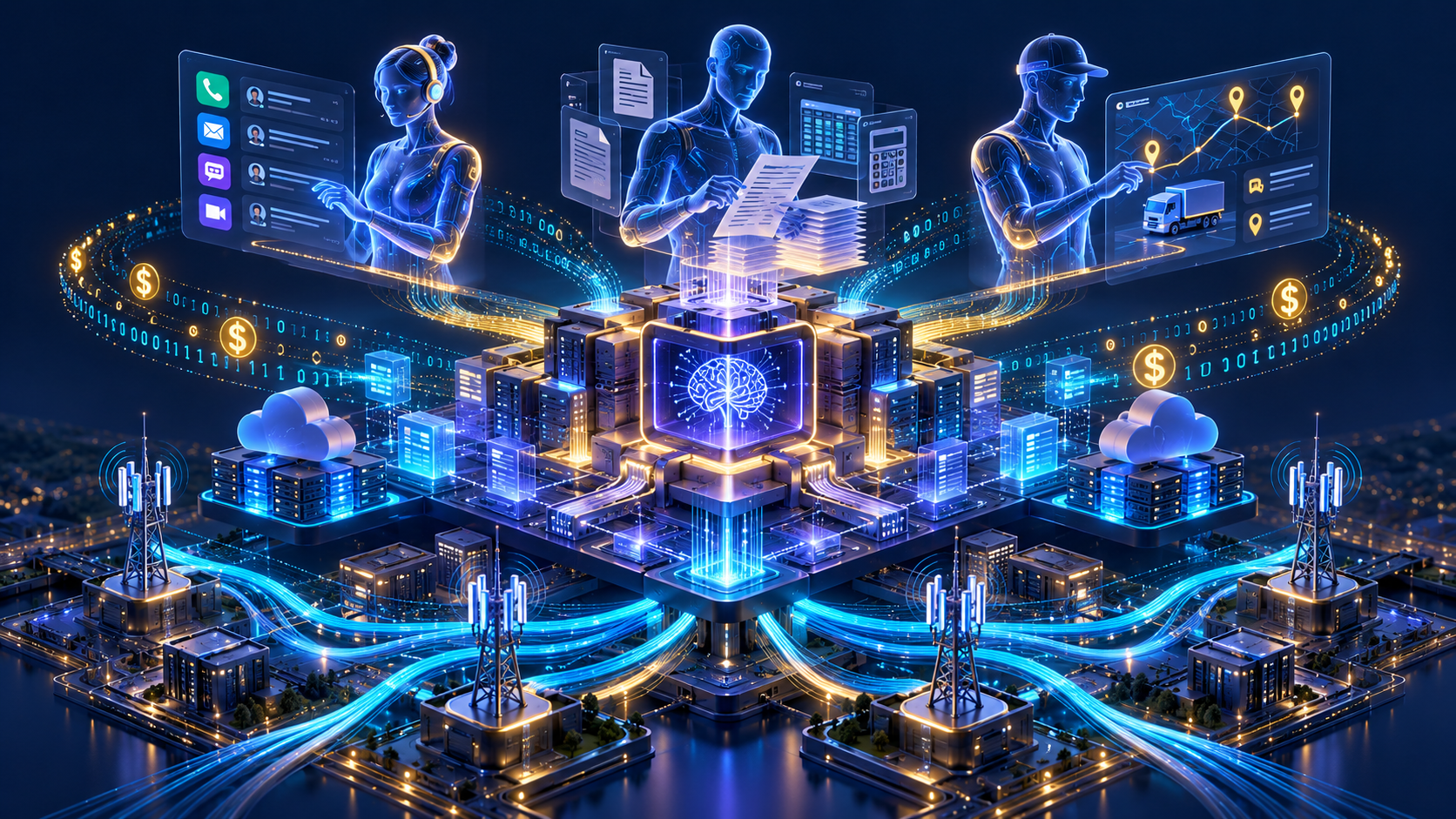
This convergence of data, AI agents, secure cloud environments, and high-performance networks changes what businesses need from technology guidance.
An advisor cannot walk into an office anymore and ask if they need a few more phone extensions or a faster internet pipe. The conversation has to start at the operational level:
- Where is administrative friction slowing your team down?
- What repetitive workflows are ripe for delegation?
- Is your underlying infrastructure resilient enough to support digital workers?
- Is your data structured well enough to teach an agent how your business operates?
AI is not just another software category to evaluate. It is a fundamental redesign of how organizations convert information into execution. The companies that successfully navigate this shift won't just be the ones that adopt the newest tools—they will be the ones that build the right architecture to let digital labor run reliably, securely, and at scale.